You are the [an error occurred while processing this directive] visitor since December 10, 1995.

Fray Antonio's Homepage

Fray Antonio

A self portrait

This page is still unedited and has not been proofread

.
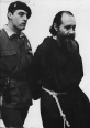
	I was 
born in the city of Cordoba on June 13, 1928. I was baptized a
few days later, on the 24th, the day of the feast of San Juan Bautista. That
is why my whole name is Juan Antonio, and they also added a third one,
Sebastian, which they gave me because of my grandfather, although I never
use it. I was baptized in the church of the Women's Prison, where my parents
had gotten married, and that functioned as the parish for the neighborhood.
Now besides it is the great Capuchine, unfortunately much larger than it
should be. 

	My dad's name was Juan Daniel. With time he will be added to the
list of the "disappeared". My mama's name was Maria Elena Fernandez. They
got married when she was 22 and he 24, very young, and they had us children
right away, very close together. We are five siblings. My baptism in the
church of the women's prison remained very important to me, and in the years
when I lived in Cordoba I celebrated mass with the most energy in that
place.  I told this once to the girls that were imprisoned, because I found
that these poor women have very open hearts. Of course, they were there for
every kind of accusations, from prostitution to the most horrendous crimes,
with or without truth, but they had such a desire to listen to the Word,
they received it so fraternally, that I would remember Jesus, whose
preferences were for these most impoverished brothers and sisters in
society, as that woman to whom he said something like "Well, don't sin
anymore, but I don't condemn you...Ó" 

	My second brother was born in Cordoba. When I was two, my parent
took us to Santa Fe. I went to school for the first time there. I suffered a
lot, I cried as a crazy boy. I remember that my mother was ill and my father
had to take me to school. Afterwards, we moved to Rosario, where my three
sisters were born. Susana, who died very young from heart problems, in 1972. 
Teresita del Nin~o Jesus, who died even younger, of cancer, after having
been very happy in her short married years with Oscar Martinez, a true
brother for us. And when the last one was born, Maria Luisa, a problem arose
that in some way upset our family. My mama became gravely ill and had to
spend several years in the hospital; my father's life was also completely
disturbed. We went from a very good financial situation, to not having one
cent. My father had been the owner of a shoe store in Cordoba; he was very
skillful, and as a good Catalan, had a great ease for business. I know that
he was too generous, he gave the shoe store to a relative. In any case, in
Rosario the illness of mama made him lose all he had. It seems that he found
a doctor who abused the situation.
	After that, we were spread out. The two boys went to stay with the
grandparents and an uncle in Cordoba. The girls stayed with another brother
of dad in Santa Fe. Dad had to go to Buenos Aires to look for a job, as it
seems that in Cordoba relatives and friends, gave their back to him. With
five children to support and a very ill wife, everything was complicated.
Dad would visit me once in a while. I remember with sadness those years, how
painful it was to see mama in the neuropsychiatric (hospital) where she was
staying. When se finally left, practically cured, she worked as a teacher in
the Franciscan school, located in the center of Cordoba. I was attending the
seminary in Rondeau street, where she was a teacher, and I remember that I
would help her making woodwork for the classes or drawings to teach children
to count.
	Though we had an abnormal family life because father was far away
and his visits were more and more rare, mama had the great virtue of making
us love him very much; she always described him as the distant father,
suffering a lot, working for us and not finding the financial manner to live
with us. She never had a word of complaint about that absence without an
end.
	Living in Cordoba, when I was nine, I began to go to the Capuchins.
For a long time before this we would go to mass with the grandparents, with
mama herself when she was well. Very early always, at 5 AM. And then I began
to listen to the mass, with the support of brother Fray Eduardo, who taught
me some Latin. Talking to them, I was attracted to the Capuchin order. Now I
sincerely confess that I did not understand at all what it was about. I knew
that Saint Francis was the founder of the congregation, but that was all.
Mama told me that I wanted to be a priest since I was five. I remember that,
soon after, when I had my first communion, I said "I am going to be a
priest", and my brother somewhat bothered -we loved each other very much but
we lived fighting-: "And I am going to be a saint!."
	Perhaps what seriously brought me to the priesthood was the piety of
my mother, the admiration she felt for the priests, for whose sainthood she
always had a special prayer. But I don't know why I made that decision. Now,
the stuff about the Capuchins, was very curious, because it was something I
was very decided upon. Mama worked with the observant franciscans, a branch
of franciscanism, and when I asked her, she was considerate enough to
consult my father in writing, and he sent a letter accepting my decision of
entering the seminary. I remember that the director of the school would say:
"But lady, how are you going to send him to Buenos Aires, such a distance,
if he is a child!". He was right, but I didn't want to know anything about
it. He was insisting that I tried with them first. It seems that he didn't
see much of the right stuff in me. Now, analyzing it, thinking from faith, I
think that I follow the path of God, what we call providence, something that
guide us and should influence in what's human, because at that time, in
1940, to travel to Buenos Aires and even more, an 11 years-old boy, it was
still an adventure, specially for the children of our social status. Mama,
not paying too much attention to my vocation and noting that I was somewhat
a slouch in school, wanted to guide me to become a teacher. But I was
decided, and I remember the emotion when we finally fixed the date of the
trip. The last days I had the gift of not having to go to school and
spending morning and afternoon riding the bicycle, that some cousins in a
better position had given us, and which I enjoyed as if I was in glory.
	Amidst the difficulties, I had a very happy childhood. I remember
that at the time in the Catholic Action they would offer movies in the
afternoon, and my cousins invited me to see a Tarzan movie. Full of
happiness, I told my mother and very serious, she told me: "Ay, my boy, what
a disappointment. I thought that you were going to devote yourself to God.
So, you will have to choose: or the seminary or the cinema." I wanted to
complain, but she was inflexible: "If you want, go to the cinema. But forget
about the seminary." I had to chose, of course. Though I was embarrassed to
tell my cousins. And she made me: "No, no excuses. You have to go and tell
your cousins that you are not going because you have to go to seminary."
Mama was rigorous. She educated us like that, with the proper mistakes of
that time (specially, in all matters of sexual education; I remember that
once I asked her what it meant "to not fornicate" that is a commandment, and
she told me: "Go ask that of your Confessor"). With respect to my trip, mama
would talk a lot to me about it, she would make me see the difficulties of
being a priest, specially the lack of a family. But she never imposed
anything on me, she was very respectful. And I have present the tenderness
with which she prepared everything for me, poor mum, amidst such great
poverty. She had the list of things that I had to take written in a piece of
paper: two undershirts, two underpants, some handkerchiefs, everything like
that, and she would buy it slowly, and in each thing she would stitch the
initials, J.A.P., with a very elegant gothic letter, as it was in style at
the time.
	When the time came for my departure she was bothered because they
wanted to send me alone. She stood firm, and said that if someone didnÕt go
with me, I couldn't go. How could a child from the provinces be sent alone
to a great unknown city! The fathers then decided that F. Agustin, an old
man, would go with me. The farewell was a big event, all the relatives came
with me to the station. I remember that the last words of my mother were:
"Did you already kiss your brother?" As usual, we were fighting...
	Unfortunately, due to the lack of communication, my father was not
told in time of my arrival in Buenos Aires. And that absence hurt me a bit.
It was the winter of 1940, and we arrived, thus, to the seminary, that was
in Pompeya, what now is the school, a small building, and I remember vividly
that I suffered a very disagreeable shock. Afterwards, analyzing it, I think
that it was like a drowning sensation, from the time I went in. The basque
priests that directed it had imposed a very strict regime. They had norms
that seemed to me to be rather "sanguinary". As soon as you would go in,
they would shave your head, leaving only a lock of hair, they would give you
a gray, mid-leg length smock, all the time in a line, in silence. I began
missing from the same moment that I arrived. I cried 15 days in a row. And
what was curious is that I didn't want to leave, because the director,
seeing that they days went on and I continued crying, would ask me and I
would say: "It's because I'm missing everyone". And he would say: "Well,
let's do something, you already saw this, you go back home and next year you
return". "No -I would answer- because I want to be a priest."
	Because in reality, it was the priesthood what I was attracted to,
and not to religious life itself. That is what I discovered many years
later. Today I value religious life immensely as a service to God, but at
that time i was convinced that it was something that God himself was asking
me for, without knowing or understanding what for nor in what way I was
going to live, specially at the age I was. I was a lazy about studying, and
I remember that when I arrived -we were 33 children, more or less my same
age- and hearing how they were all declining out-loud in Latin, I was filled
with terror. "This is Chinese, -I thought- I will never learn it". I was
filled with such panic that I clung to the book and a little while later I
was studying to see I could catch anything and could catch up. Because I had
arrive in may, and the classes had begun in March. And it was that zeal
which soothed me a little, although I couldnÕt defeat the pain and the
tears. To the point that I was in class and many times I would get
distracted thinking about mum and my siblings, and bye, I was a Magdalene.
The children would scream: "Father, Puigjane is crying". And he, tired of
it: "Leave him alone!"... And like that for many days... In addition, there
were no children from Cordoba in the group, formed by children from
different provinces. I thought that they were crazy when they would tease me
for my sing-song, themselves, when each one of them had their own one...
	Well, the fact was that I began studying with a lot of zeal, and
that a few months later I had the first awards.  The yearning I showed was
so great that my mum in the letters that she sent me would say about that
"Ay, my child, how thankful I am to God!." They were beautiful letters. A
director from the seminary told me years later that those letters would be
enough for a spiritual reading, they were so filled with advice and love. In
a rapture which I thought of generosity, to detach myself from everything,
including the diary that I was writing from the day I entered seminary, I
made the mistake of burning everything when I entered the novitiate, eight
years later. I never regretted this enough.
	The living regime was more or less the following: that first year,
after waking up in the morning, we would pray, then we would have breakfast,
and we would go to the public school to finish primary school. I remember
that I was very pituco as a child, I liked to wear gel, comb myself well,
and have my tie well tied up. The only horrible thing was the baldness, and
because of that I was ashamed of going outside, specially after the second
month, when they shaved off all the hair I had left.
	Dad would visit me every sunday: in that he was very consequent. On
December 8, when classes ended, they gave us a day to go out with our
relatives. It was the only time I left the seminary, and I was able to see
the center of Buenos Aires, the for me very high Cavanagh, which impressed
me a lot.
	From there, we went to the seminary of O'Higgins, also of the
capuchins, where I spent seven years. It was in part a lower seminary and in
part a higher one, doing 5 years of humanities (including the one I did in
Pompeya) and 3 of philosophy. The system was well organized, and in
comparison with the one in Pompeya, it was harder, military-like, with a
great dosis of spirituality, but extremely rigorous, as the good basques who
directed it. For example, one would look to one and other side or talk out
of turn and they would make you kneel and would three slaps that would throw
you to the floor. Or they would make you walk around the court for hours in
a feast day, or to do it ten days in a row, during break time, with the
hands behind you, while the others were playing. It was a very harsh
discipline.
	We had to get up very early, spend more than an hour praying, have
breakfast, then study, only at midmorning we had a half an hour break, when
we could talk, study some more, go the the Most Holy, where we would pray,
and have something to eat. Most days we could not talk during lunch; we
would read in turn. According to how I see it now, they used this to train
us to speak publically, because they would not let you make a mistake in a
coma, they would make you repeat, until humillation.
	We would do a lot of sports in the few moments that we had:
raquetball, I liked that a lot, and a bit of soccer, where I wasnÕt very
good; or we would work the land. But we would never leave. We were repeating
that from the gospel: "He who puts a hand to a side, and looks back, will
not jump to the kingdom of heaven." He who entered would leave as a priest
when he finished, or he would abandon. We could receive visits but we could
not visit anyone. I remember that my mother wrote a tremendous letter
protesting because she had given her child to God but did not believe that
God was so cruel that would ask her for so many years without my being able
to see her.
	And it's curious, regardless of the very harsh discipline, many
times close to brutality -and I have met compan~eros that remained bitter
forever because of that- I, perhaps for my temperament or by the grace of
God, was able to digest it. And I still remember that estage as something
joyful, that did not bring me doubts about my vocation, quite a strange
thing. Afterwards, whne I was an educator, I have seldom seen boys who do
not have their serious lows. The case is that of the more than thirty of the
group that entered in Pompeya, I was the only one left for the priesthood.
They began desserting by their own decision or because they sent them home.
Everything was very rigorous: there were certain faults, as rebelliouness,
sexuality problems, and out. There was no consideration. Or those who did
not do well in their studies. The decanting was terrible.
	Looking at this now, I would in no way advise a boy to enter the
seminary at the age at which I did it, even though I was very happy. But I
understand that it's playing with fire. A lot of harm can be done to the
boy, putting him in a path that may not be his own; specially in the way it
was done then, when they would describe the priesthood as the only way to be
faithful to what God wanted. They would create, perhaps unconsciously, a
spirt of cast, of elitism. That is what is most noticeably in the clergy.
Because there is nothing more similar to a military base than a seminary,
and there nothing more similar to a general than a bishop...
	It was, then, years of a rigid live, of a lot of studyng. I could
only read one or another novel as a vacation, and that with great
precautions; Hugo Wast, Jules Verne, and thanks.  We would work the earth
and that was good.  From being a theologist, I was in charged of the chicken
coop, or the bees. They also gave us the opportunity to study music and
practice some instrument. And the poor Basques were so out of it, that they
taught me how to play the "chistu", a type of "quena" from their land, with
a very loud sound, used in the mountains to call the lost animals.
	The harshest part of our formation was the total isolation in which
they kept us. Afterwards they said that that was so that we would not see
girls, as that would put our vocation in danger. I remember that those who
would look out the window in class, would be thrown out. Why? Because from
that window one could see the people who were leaving the church. Not from a
whorehouse, but from mass! We could not see a woman. One has to have
compassion for the poor priests, for their formation. Fortunatelly, that has
changed a lot, though our current bishops grew up in that environment. And
we could not even have a radio. I was only able to have one when I became a
priest and a professor at the seminary, and that with chicanas. We never
read a newspaper. The world was living through a horrible war, and we didnÕt
know about it. Perhaps the idea that reality was sinful was prominant, and
they would expect us to be pure, clean, devoted, far away from everything.
	One asks oneself how they could collate the teachings of San
Francisco, his devotion to the por, his militant life style, the fraternity
among his followers, with this repulsion for a world considered evil. There
is a phrase that condenses our whole education. They would tell us that we
had to to walk "The hands in the sleeves, the eyes in the floor, and the
heart in heavenÓ. And they would require you to be like this, and they would
watch you, they were distrustful, and they would punish you... And this is
how they had been educated, poor people...
	That's why Saint Francis did not weigh at all in our education, he
was just another saint, though the most loved one. With shame, I must say
that it was not the order who guided me in the discovery of the path towards
the people. It was the people themselves who enlightened me. Even when I
believe that my condition as a follower of Francis was essential for me in
trying to live the poverty, the humility and the struggle of the people.
	Around that time, during my second year in philosphy, I was able to
go home after so many complaints from my mother, who received me with many
tears and surprise as she could not believe how I could have grown up like
this in those eight years I was away. I was so out of it, that the second
day I wanted to return to the seminary. My brother wanted to talk to me
about girls, and it seemed so absurd to me, so obscene. And he was only 17,
and I a year older.
	In 1949 I passed to the novitiate, which was in San Francisco de
Llavallol, in a huge building built specially for it and that fortunatelly
we gave to the bishop. Today we even want to have the novitiate be in La
Cumbre, in Cordoba, a simple house but in a very nice place, and of course,
very burgois. With great joy in my part tow of the boys work as cirujas, and
I think San Francisco must be licking his lips of happiness seeing these his
sons as hobos. 

To be continued....