| Information |  | |
Derechos | Equipo Nizkor
| ||
| Information | | |
Derechos | Equipo Nizkor
| ||
21Sep22
Investigation requested into the persecution, kidnapping, and torture of members of the National University of the South; civilians and former military personnel indicted
The Public Prosecutor's Office (MPF) identified the cases of 30 victims from the university community who were prosecuted, imprisoned, and tortured during the last dictatorship, as part of a criminal plan that included stigmatization and incitement to genocide by the newspaper La Nueva Provincia and coordinated action by the federal judiciary and the armed and security forces.
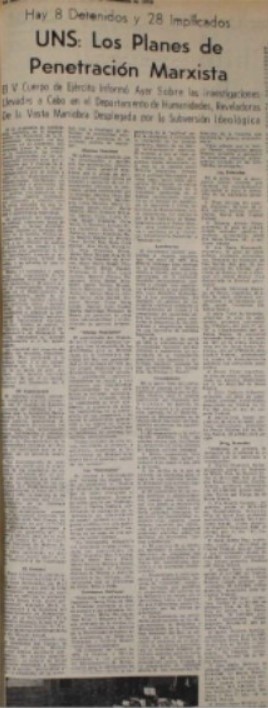
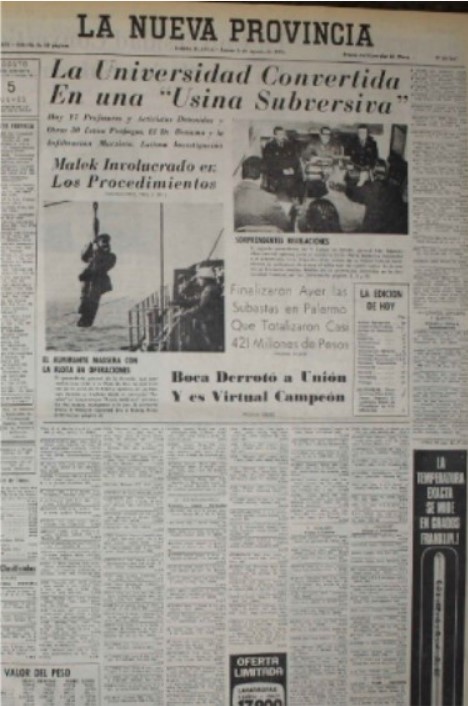
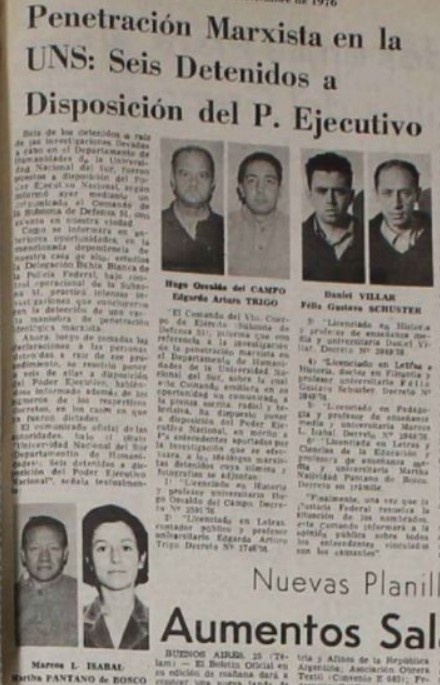
Editions of the newspaper La Nueva Provincia from November 13, 1976 (left) and August 5, 1976 (right).
Images provided by the Bahía Blanca Human Rights Prosecutor's OfficeThe Bahía Blanca Human Rights Prosecutor's Office launched an investigation into the kidnappings and torture suffered by faculty and students at the National University of the South (UNS), events it characterized as part of a plan of political persecution involving coordinated action by the federal judiciary, the media conglomerate led by the newspaper La Nueva Provincia, and the armed and security forces. According to the investigation request, this plan was implemented through two judicial proceedings, one targeting faculty members in the Department of Economics and the other those in the HUmanities Department of the university.
The 30 victims whose cases form part of the subject matter of this presentation were kidnapped during operations carried out between June and November 1976. At the time, they were professors of Economics, Literature, Philosophy, History, Mathematics, and Biology at the UNS; members of the social psychopedagogy department at the university’s secondary schools; faculty and students at the School of Social Work; and students and teachers at the National High School of Bahía Blanca. Some of the victims were forced into exile.
"The victims were kidnapped by agents of the Argentine Federal Police; they were first detained and subjected to violent interrogations at the police station of that force located in the city of Bahía Blanca, before being transferred to Penitentiary No. 4 in Villa Floresta. In some cases, this prolonged captivity continued in other prisons across the country," the Prosecutor's Office described in its statement, in which it also highlighted the suffering reported by the victims, including what they described as "civil death," characterized by exile for those who left the country and ostracism for those who remained after regaining their freedom.
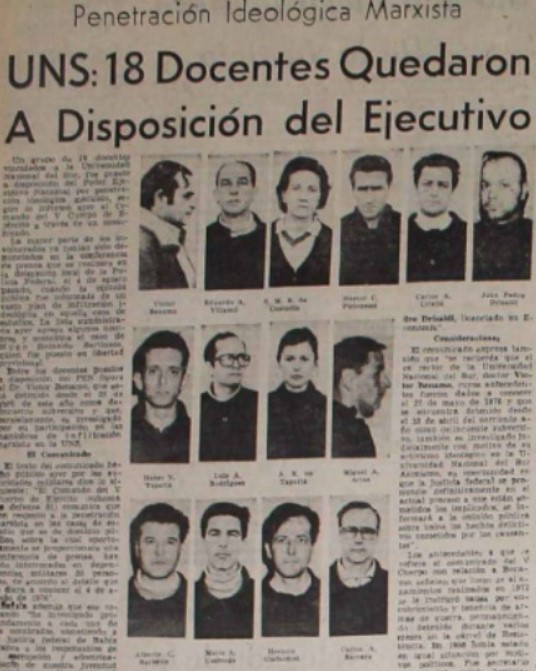
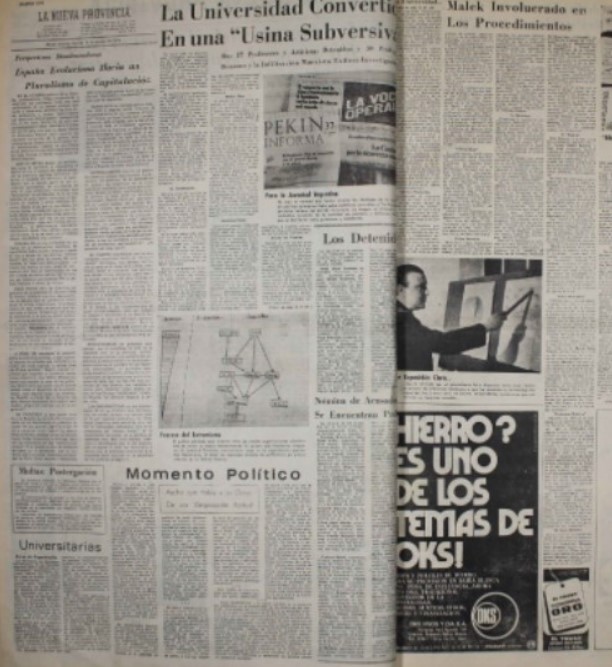
Editions of the newspaper La Nueva Provincia from October 27, 1976 (left) and August 5, 1976 (right).
Images provided by the Bahía Blanca Prosecutor's Office for Human RightsThe individuals charged by the prosecutor's office in connection with these events are the former owner of La Nueva Provincia, Vicente Gonzalo Massot; the former clerk of the Bahía Blanca Federal Court, Hugo Mario Sierra; the military officers Osvaldo Bernardino Páez, Osvaldo Lucio Sierra, Enrique José Del Pino, Jorge Horacio Granada, Carlos Alberto Taffarel, Norberto Eduardo Condal, Víctor Raúl Aguirre, Antonio Miguel Seghighi, Roberto Carlos Brunello, Raúl Esteban Andrés, and Alejandro Lawless; as well as former prison director Héctor Luis Selaya, regarding whom a request was made to summon them to provide preliminary testimony.
"The University of the South was a space of cultural resistance to the complicit discourse of La Nueva Provincia. That is why professors and students became symbolic targets to attack. We have demonstrated that the attack was coordinated from three sectors: the media, the judiciary, and the repressive arm of the security forces," emphasized Mr. Palazzani.
The University as a Strategic Target of State Terrorism
The submission, signed by the head of the Unit, Attorney General Miguel Ángel Palazzani, highlights that the UNS was a target —specifically the Departments of Humanities and Economics— as part of a persecution campaign that began before the 1976 coup d’état, under the administration of rector ("rector interventor") Remus Tetu, through the introduction of a parastatal group within the institution, the mass dismissal of teaching and non-teaching staff, and the assassination of students, including on university premises, as was the case with David Hover Cilleruelo.
The prosecution stated that, following the coup d'état, the plan intensified through a joint and coordinated effort involving the federal judiciary, the daily newspaper La Nueva Provincia, and the repressive forces, designating the victims as enemies labeled "ideological subversives" who had to be annihilated as part of the cultural war advocated in the newspaper's pages, dwithin the framework of the psychological warfare phase of the criminal enterprise.
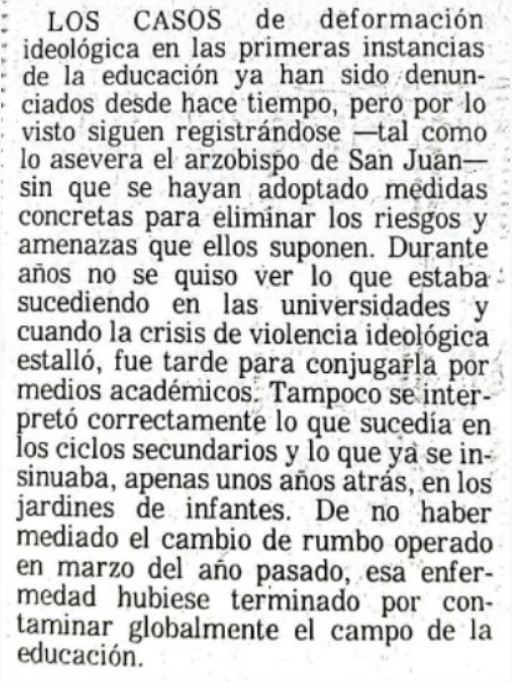
Editions of the newspaper La Nueva Provincia from November 13, 1976 (left) and August 29, 1977 (excerpt published in the editorial).
Images provided by the Human Rights Prosecution Unit of Bahía BlancaCrime of Persecution
Beyond the criminal classification provided for in the National Criminal Code, prosecutors characterized these acts as a crime of persecution under international law, consisting of the intentional and severe deprivation of fundamental rights on the basis of the identity of a group or community.
"The victims of this case --labeled by the terrorist state as ideological subversives-- share the characteristic of having taught at the university level and having participated in academic life within an institution of higher education --the National University of the South-- during the same historical period, spanning from the end of Juan Carlos Onganía's civil-military dictatorship to the 1976-1983 coup d'état," noted the prosecutor's office, which cited as a precedent the "Ricchiuti" ruling of the Fourth Chamber of the Federal Criminal Cassation Court, which recognized the international crime of political persecution.
In its submission, the Prosecutor's Office pointed out that the aforementioned judgment stated that the facts "did not occur in isolation, but were part of a complex system of illegal state repression and persecution on political grounds." In this context, the prosecution emphasized, the focus was on the "violation of fundamental human rights" and the "repeated nature of such acts committed against individuals persecuted on account of their (real or alleged) affiliation with so-called 'subversion' [which] allows us to infer in this case the 'political motivation' referred to in the international standard that criminalizes persecution on grounds of this nature."
The prosecution noted in its brief that the aforementioned ruling stated that the events "did not occur as isolated incidents, but were part of a complex system of illegal state repression and politically motivated persecution."
La Nueva Provincia
The submission highlights that "in 1976 and 1977 alone, there were 237 different issues in which the 'struggle against subversion' was addressed in its pages, of which 177 issues associated (verbatim) 'subversion' with the verbs eliminate, annihilate, combat, fight, kill, attack, extirpate, cleanse, and eradicate, as well as with a 'state of war'."
"The statistics themselves show that the newspaper's commitment to persecution, targeting, and incitement to violence against professors at the National University of the South was clearly central and direct: of a total of 237 issues devoted to the theme of subversion, more than 80 editorials were specifically dedicated to the realm of 'subversive ideologues' in universities, presented as a necessary and priority target in the fight against subversion, calling for their annihilation by the same methods used against the armed guerrillas. "In other words, the persecution of the group of victims targeted by this order accounted for more than a third of the discourse inciting genocide," the Prosecutor's Office emphasized.
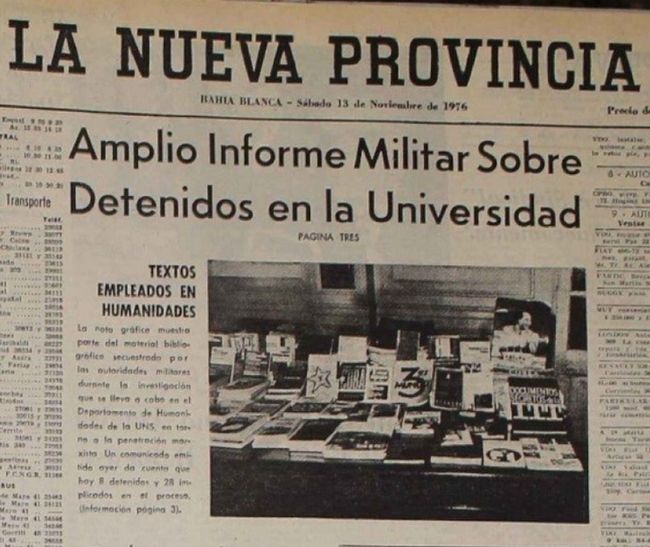
Editions of the newspaper La Nueva provincia dated November 13, 1976.
Images provided by the Human Rights Unit of the Bahía Blanca District Attorney's OfficeThe findings indicated that the scale of the persecution was such that, in its August 29, 1977, issue, the newspaper stated that "new forms of Marxist aggression […] carried out covertly and through infiltration at various levels of society […] are already manifesting themselves in kindergartens, where they are beginning to subtly shape the minds of children." This statement was part of the editorial titled "The Country at a Crossroads. Vital decisions that can no longer be postponed. ("El País en la Encrucijada. Decisiones Vitales que no Deben Seguir Postergándose").
The presentation highlights the coordinated efforts of major newspapers and publications —featuring front pages with banner headlines and leading stories— the progress of legal proceedings brought by the federal court, and the actions of law enforcement agencies.
Among the publications reviewed in this 353-page presentation are the following articles:
- On August 5, 1976, the newspaper published an article titled "The University Transformed into a Subversive Hotbed," with a subtitle stating that "17 professors and activists are in custody and 30 others are on the run. Dr. Benamo and Marxist infiltration. A successful investigation."
- On October 27 of that same year, it published close-up photographs of the victims under the headline "Marxist Ideological Penetration. UNS: 18 teachers placed at the Executive's disposal."
- With the front-page headline "Detailed Military Report on Detainees at the University" and the inside headline "UNS: Plans for Marxist Infiltration," on November 13, 1976, it worte that "the 5th Army Corps reported yesterday on investigations conducted within the Department of Humanities, revealing the vast maneuver deployed by ideological subversion."
- On November 26, 1976, the newspaper again published photographs of the victims under the headline "Marxist Infiltration at UNS: Six Detainees at the Executive Branch's Disposal."
- On June 23, 1977, it ran the headline "Infiltration at UNS: Revelations" on its front page.
The presentation notes that "in 1976 and 1977 alone, there were 237 different issues in which the 'fight against subversion' was addressed, of which 177 issues (literally) associated 'subversion' with the verbs eliminate, annihilate, combat, fight, kill, attack, extirpate, cleanse, and eradicate.
The Role of the Federal Judiciary
The prosecution emphasized that the unlawful deprivations of liberty and acts of torture were carried out with the “significant and necessary contributions” of officials of the federal judiciary at the time, primarily federal judges Guillermo Federico Madueño and Jorge Francisco Suter, court clerk Hugo Mario Sierra, and federal prosecutor María del Carmen Valdunciel de Moroni, through the initiation of the cases "Ramírez, Stella Maris et al." and "Del Campo, Hugo Osvlado et al.," which served as instruments to conceal the criminal nature of these acts.
As an example of the synchronization and alignment with the indispensable contributions of the daily newspaper La Nueva Provincia, the prosecutors cited excerpts from the judgment rendered by Judge Suter and published by the newspaper under headlines such as "The Country Facing Subversion," "Subversion in the Academic World," "Overview of the Situation at the UNS in 1973-74," and "Academic Freedom and Ideological Infiltration".
These articles include direct quotes from the judicial ruling, such as:
- "We know that subversive activities also had an impact —whether through direct action or indoctrination— in achieving the goals set forth in the cultural, labor, political, and educational spheres, at both the secondary and higher education levels."
- "While Argentine families, hoping for a better future for their children, sent them to university, they could never have imagined that in that environment, professors--themselves Argentines (and foreigners)--would use their positions to inoculate them with the virulent germ of Marxism-Leninism, which is precisely, as we have said, totally contrary to our Western and Christian way of life, aiming at the destruction of the primary cell of society: the family. The result is thus a paradoxical situation: the young person sent to study at the university--who knows at what cost to the family--suddenly finds himself, under the influence of these teachers (busy transmitting those ideologies and paid by the state), confronted with the latter and with the society it is part of, in a senseless struggle aimed at destroying them."
- "Everything that happened in 1973-1974 must serve as a warning to us, so that the events we were forced to endure in various aspects of national life are never repeated in our country. It is unacceptable that, under the guise of university autonomy, academic freedom, or whatever else one might call it, attempts are made to change the mindset of our children."
- The judge emphasized "the fact that three foreign professors [whose full names are cited in the ruling], with complete impunity but thanks to resources provided by Argentines, were able to operate at the local university, apparently carrying out their distinctly left-wing teaching activities without hindrance."
- Finally, he concluded: "[g]iven the seriousness of the aforementioned crime, which takes on even greater significance in light of the setting where it was committed —university classrooms— the age of the students, and the subsequent influence they will have on all aspects of social dynamics, the premeditated intent of [one of the defendants] to distort the truth, taking advantage of his position as a professor —which was his profession— to disseminate political and philosophical ideas whose ultimate aims are to suppress or alter the institutional order and social peace of the Nation through means contrary to the Constitution, and that the unlawful conduct exhibited by [the defendant] has been clearly and objectively demonstrated, I consider that the sentence sought by the Public Prosecutor’s Office should be increased to five (5) years' imprisonment."
"The University of the South was a bastion of cultural resistance against the complicit rhetoric of La Nueva Provincia. That is why professors and students became symbolic targets for attack. We have demonstrated that the attack was coordinated by three sectors: the media, the judiciary, and the repressive arm of the security forces," Prosecutor Palazzani told Fiscales.gob.ar.
[Source: Human Rights Unit of the Bahía Blanca Prosecutor's Office, Office of the Attorney General of the Nation, Bahía Blanca, Argentina, 21Sep22]
 Radio Nizkor
 | This document has been published on 29May26 by the Equipo Nizkor and Derechos Human Rights. In accordance with Title 17 U.S.C. Section 107, this material is distributed without profit to those who have expressed a prior interest in receiving the included information for research and educational purposes. |