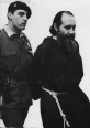


The Defense has put a special emphasis in underlining the presumed coincidence between the opinions of Juan Antonio Puigjané and the so called "liberation theology." The position that the accused could possibly espouse within an internal dispute of the creed to which he belongs, is not subject to debate nor can it be, in any way, object of legal persecution; in the same manner, the political position and the opinions that he might have made within the frame of legality and answering this political theological conception, can neither be the object of persecution. However, the concrete conduct of the accused must be analyzed, and whether they constitute criminal actions, independently of the frame in which they have been developed.-
Juan Antonio Puigjané began his militancy in the Movimiento Todos por la Patria [All for the Fatherland Movement] since its own origins, he was even one of the members of the first board of directors that the group had, around May 1986. From that moment on and until the present, he belonged without interruption to the top directive organisms of the movement, that is, to the National Board, the National Secretariat and the Political Commission.-
In this capacity as a top leader of the movement he participated in the meeting carried out in December 1987, where a fracture of the group took place and it was decided to incorporate Enrique Haroldo Gorriaran Merlo, with the reach and meaning that that had, as it has already been analyzed. This incorporation was voted affirmatively by the accused, because according to his words, it did not seem abnormal to him to include in the top directive organism of the Movement a person who was a fugitive from justice because of his active participation in acts of political violence.-
The story of Gorriaran Merlo seems, by itself, an important clue of the real meaning of his entrance into the Movement. This clue is reinforced by the different documents emanated from the organisms that Juan Antonio Puigjané integrated. In that sense, we must cite the documents "Some criteria and postures of the MTP in the political-ideological struggle" and the pamphlet 1/87; in both instruments the continuation of the struggles of the guerrilla groups of the decades of the 60's and 70's, is postulated.
I am not overlooking that the accused has denied the authorship and knowledge of such documents, however his excuses must be rejected according to the expressions made by Puigjané himself in his discovery declarations and also by Felicetti who only disentails him at the end.-
In that opportunity the accused admitted his active participation in the different organisms to which he belonged, and he also indicated that he participated in the meetings of these organisms to which he made his contributions, acting actively in the Secretariat as the other members did and he finally admitted that he shared the political alignment of the group. If all the indicated documents are the fruit of the discussion within the organisms in which he acted at the same level as his equals, and if such instruments are the ones that marked the line that he embraced, one cannot understand how he can then deny that he intervened in the creation [of the documents] or at least in their knowledge.-
This vindication also formed part of the content of the document "MRB=MTP, contributions for the building of the revolutionary movement of base."-
Although what has been expounded is enough to consider the accused as being mendacious, the fact that Puigjané himself was the writer of the document called "Mini history of the MTP" does away with any doubts. He admits there without ambiguity that the history of popular struggles, a struggle that the MTP comes to continue, was formed, among other elements, by the "diverse armed, guerrilla groups of the 60's and 70's." The prosecution's allegations about the fact that what was advanced in the pamphlet 1/87 is completed through this document turns out to be precise, when you notice that Puigjané himself maintained in his questioning that he undertook such work as an assignment of his co-members. And this is not an isolated incident in the history of a political line but, to the contrary, a step precisely established as a step to the object of the group, which was that of making up a sector of cadres absolutely imbued with the position that would finally lead to the taking of power, for which the relevance that the figure of the fray had over certain catholic groups could not be unexploited.-
The participation of the accused in the group cannot be analyzed out of the context marked by the characteristics that the leadership of the movement assumed, and the necessary requirements for taking part of it.-
In this sense, we cannot but mention again the document "MRB=MTP contributions for the construction of revolutionary movement of base"; which indicates the internal consolidation of the Movement, its ideological hardening and its organic cohesion; it indicates that the leader must not be one because of his oratory but because of his knowledge and consubstantiation with the line of the MTP; it maintains also that for the achievement of this line it is preferable that a member of the leadership withdraw from it rather than stay setting forth disidencies, because it would be the homogenization thus achieved what would allow for the achievement of the line through the strengthening of the authority of the leaders. It is useful to remember here that the line that was drawn in that opportunity and with which the leaders had to consubstantiate themselves inexorably, basically meant the taking of maximum advantage of the spaces of legality in the country to begin diverse criminal actions such as the taking of factories, universities, etc., to form a parallel military structure to the political structure of the MTP, which would allow the Movement to be not only the political "wing " but also the military "wing" of the revolutionary struggle that they would begin themselves, applying the criteria of security for the moment of the movement into clandestinity, etc.. That, as was said, according to what the document itself says.- In an identical sense that to referred to, the instrument 'the cadres and the organization' set forth that the leader must be a man decided to fulfill the line, be a symbol of fidelity and devotion of the accomplishment of this line.-
In the context referred to, Juan Antonio Puigjané was one of the five top leaders of the All for the Fatherland Movement together with his co-accused Roberto Felicetti, the fugitive Enrique Gorriaran Merlo and the fallen Jorge Baños and Francisco Provenzano.-
Juan Antonio Puigjané maintained in his questioning that he did not know the first of these documents. This assertion must be discarded for the reasons set forth when we analyze the legal frame that we should give the association,; the facts have shown throughout the debate that the document "MRB=MTP' was not an isolated action of Jorge Baños extraneous to the will of his co-members, since all the directing lines that are consigned there, were taken to practice.
In the same document, Puigjané is mentioned as one of the spokesmen of the movement, which happens not because of his personal conditions but for belonging organically to the leadership. The same happens in the manuscript titled "Questions", seized in Graham Bell 2780, where he is nominated as calling spokesman of the Movement. It is obvious that such a function would not be given to someone who was not part of the noted structure.-
If we observe that the directing lines established by the document analyzed above have been accomplished; if we see that according to them it is impossible that someone who is not consubstantiated with them be a national leader, if finally we appreciate that Puigjané is one of the spokesmen mentioned in "MRB=MTP" and in the document mentioned above where it was set forth how to present the events of La Tablada, we will easily understand why the alleged ignorance of the accused must be discarded.-
Thus, then, we consider Juan Antonio Puigjané as one of the top leaders of the All for the Fatherland Movement, with the characteristics so established by that leadership. He is considered, thus, responsible for the documents incorporated to the debate.-
It is clear that the participation of Puigjané in the highest leadership organisms had a special significance; notwithstanding the fact that he was an active member in these organisms besides his colleagues, without doubt the accused exercised a moral ascendancy over the militants and even over the leaders themselves. What has been set forth comes from his own declaration when he declared this in a generic way and then in greater detail in reference to his relationship with Carlos Samojedny.-
Puigjané maintained that his militancy was permanent until December 2, 1988, the date at which he distanced himself from the Movement for pastoral reasons.-
Diverse proofs contributed to the debate allow us to refute such statements and to label his sayings as mendacious.-
On the same Dec. 2, and on the 4th, 5th and 29th of December he appeared signing press releases from the group. On December 3, he published with other of his co-members an open letter in a Buenos Aires newspaper whose text has been incorporated into the debate; in the same way towards the end of the year he participated in the discussion previous to the publication of the pamphlet "It is the Hour of the People", according to what his co-accused Felicetti has maintained; he participated as well in the press conference of January 16 of the current year, where the movement made the denunciation of an alleged civic-military pact destined to overthrow the then President of the Nation, according to what Puigjané had admitted himself; in the same manner, he was present at the premises of the group situated in Tucuman 2250, together with Francisco Provenzano, two days before that press conference, this according to the testimony of journalist Mario Nicolas Avellaneda. In addition, at the end of the debate he acknowledged having received with the other members of the secretariat, the information referring to an imminent coup d'état, notwithstanding the fact that his consort Felicetti tried to disassociate him from the situation when he gave a deposition. This episode, according to what was also declared by Felicetti, must be placed in the afternoon hours of January 20. Finally, on January 21, he took place in the convocation and moving of people who would execute the uprising here judged, according to what will be analyzed below. In synthesis, from the time he said he had abandoned the leadership of the movement for pastoral reasons until the date when the events under investigation took place, a time period of only a month and a half, the participation of Puigjané on ten occasions has been proven, what allows, as I advanced, considered his statements as false.
In my judgement, the circumstances that the accused alleged to have distanced himself precisely in the days before the attack on the military base is not casual. In the same way that his alleged lack of knowledge of any documentation placed him in the margins of the illicit association, his distancing at that time would additionally have made him not responsible for the criminal acts of January 23 and 24.-
The accused Puigjané maintained that on January 21 he went to the house of the Veiga brothers to remind Ricardo that he should go to a meeting planned at 7pm in a place unknown by the accused. He pointed out that as Ricardo Veiga was not home, he went to look for him at the place where he was working and he led him to his home, leaving him at that time. He denied, moreover, having had any relationship with the attendance of Claudio Veiga to said meeting. He made clear that he was doing the convocation as an errand for Francisco Provenzano, who the Friday before, in the morning hours, had gone by his home in order to ask him to convoke the Veigas. The accused Puigjané insisted on his lack of knowledge about the reason for the meeting that Provenzano was asking him to convoke the named Veiga. But if the words of the accused are recalled, in particular those of Felicetti, Dora Molina, Gabioud Almirón among others, the question of resisting with arms the alleged coup d'état, was a subject that mobilized the members of the criminal association. It seems totally unbelievable that the leader Provenzano -probably the one with the most intense participation in the organization of the crimes that are being investigated-, would not make it known to another leader -of the importance of the accused Puigjané-, the motives that concerned not only the top leadership but so many other members of the criminal association, that a few hours later would commit the crimes for which they were judged. It seems naive and contradictory with the situation set forth by the accused themselves to assertion that Puigjané sent the Veiga to "one more of so many meetings."-
From the critical analysis of the statements by Liliana Edith Veiga and Julia Francisca Castañares, during whose testimonies one was able to clearly appreciate, given the innumerable imprecisions that they presented, an overloaded spirit tending to favor the accused, as also from the [testimony] of Francisco Terracino, comes that Puigjané has lied, once again, when he spoke about this event.-
In the first place, his assertion that he did not call Claudio Veiga to the meetings, nor he led him anywhere, is discarded by Liliana Veiga, who testified that her brother asked her for money in case nobody would give him a ride back; if coming back was the problem, going there wasn't, because he would be driven by the only person who was present at the place and who, in addition, owned a car, that is Juan Puigjané. Julia Castañares said, in turn, to have lost worry about the fate of Claudio on January 21 and 22 because according to her son he had gone with Antonio.-
In the same way, the accused contradicted himself when he confirmed that he had gone to the home to wake up Claudio, being afraid that he might oversleep and be late. If he was not supposed to convoke him, this lacks an explanation.-
In second place, the referred moving of Ricardo to his home does not deserve credit. If Liliana Veiga arrived at that house in the afternoon hours and she remained there at least two hours according to her testimony; if Puigjané, a few minutes after he arrived, left to look for Ricardo to take him again to his place of origin, and if after two hours from this, he did not return with Ricardo, regardless of the short distance between the home of the Veiga and that of Terracino, and taking into consideration that Ricardo left immediately from the home of the latter, it is unequivocal to infer that Puigjané did not take Ricardo home.-
One arrives at the same conclusion by analyzing the testimony of Julia Castañares, who commented that she had remained calm because Ricardo had also left with Antonio.
Moreover, even when these testimonies would be left aside, as a mere working hypothesis, the version of the accused shows so many incongruities that it prevents us from taking it as true.-
In the first place, if the movement had called for a meeting of such importance, as it should be if Provenzano went 24 hours before to ask Puigjané to tell Ricardo Veiga and if he was not satisfied with complying with the request the same day, but that the next day he took care personally of guaranteeing the presence of Ricardo, one cannot explain how could the accused not know the motive for that meeting. The top leadership of the All for the Fatherland Movement had denounced days before the imminence of the coup d'état. The meeting of the 21 was convoked -according to statements by Felicetti- in order to discuss what they would do about the alleged coup d'état; in that context and if one looks at the long militancy of Juan Puigjané, there is no explanation for the accused not going to the deliberation because he had to tend to other work, and it can be understood much less when one appreciates, definitely, that instead of going to the meetings, according to his version, he went swimming.
Puigjané, perhaps knowing how weak the used argument would be, maintained that he did not know what the meeting was about and that in reality he preferred not to ask in attention to the tasks above mentioned. No credibility can be given to his ignorance. This because before the gravity of the situation that according to what has been said existed, it is not logical in Provenzano showing so much interest in the attendance of a simple militant and not in that of a co-member of the national secretariat. Moreover, if Puigjané had participated in the denunciation, if he knew then the alleged information that they were dealing with, he could not not know the purpose of such urgent a meeting. To avoid asking the obvious -that is the motive of the meeting- so through the mercy of his ignorance be able to accomplish other tasks, among them, athletics, does not agree in the least with the vocation of personal sacrifice for the community with which the character witnesses of the accused have described him.-
Moreover, the triangle Provenzano -Puigjané- Veiga does not seem reasonable either. In itself, it lacks sense that the first one would ask the second one to call the third one to a meeting and to not tell him where this would be held, because then, for the third one to be able to go he will have to communicate with the first one, which makes the task of the second one futile. But more illogical is the fact that if Provenzano really went to the house of the friar, he would not tell one of the Veigas personally, as they live practically together. The excuse given by Puigjané with respect to this -that is that it was 8am- becomes unbelievable when one sees the importance that the meeting would have.-
Finally, if the accused really did not know the reason for the meeting, he could in no way be surprised -as he was surprised according to his statements- by the presence of Berta Calvo with Ricardo, as there can be no surprise that a militant of the movement would go to a partisan meeting with another co-member.-
All these incongruities and holes have only one explanation: Puigjané, a member of the national secretariat of the All for the Fatherland Movement, knew perfectly the motive for the calling and what some members of his movement would do on January 23. Because of this, he, as well as the other colleagues of the secretariat, occupied part of the previous days calling and moving the mentioned militants to that effect.-
Even though the proof of clues has the complication of being indirect and complex, it has instead the advantage of being objective, based on facts; people can lie, the facts cannot.-
Juan Puigjané participated in the All for the Fatherland Movement since its inception; he was with Jorge Baños the only leader who remained in the leadership since its inception until the acts investigated here. In that period there was a profound transformation in the movement -according to what comes out from a simple browsing of documents of different times-. Because of this, many leaders had to leave the group; this distancing was not casual but provoked -see testimonies of Jose Liñeiro and Manuel Justo Gaggero and document MRB=MTP-, as all leaders that would remain in these conditions had to share completely the line that was being assumed; Puigjané remained and maintained that since then his militancy increased.-
Around that time the incorporation as a member of the national secretariat of a well known leader of a subversive group of past decades, who, moreover, is now a fugitive from justice, took place. Such an event was framed in a context of vindication for these groups according to the indicated documentation. Puigjané wrote one of these documents and voted for such incorporation, knowing that this was not an isolated act but that it corresponded to the illicit purposes that would guide the association from here on. The top leadership of the MTP began, the days before the attack of January 23, a campaign destined to justify their behavior and Puigjané participated in this campaign. On January 21, the top leaders of the movement were in charge of gathering and directing the militants toward the places of concentration and Puigjané did the same with two of the people that on January 23 took over the La Tablada base.-
From this and all that was said before, comes the responsibility of the accused. On this point it is appropriate to underline that throughout the long trial they have tried to present the accused Puigjané as a religious man guided almost exclusively by his concern to improve the quality of life of the most needy classes, for which purpose he began his political activities. His preaching, it was assured, only tried to modify the unjust ruling system, always framed in the limits of peaceful revolution.-
This last assertion began to be in crisis when he proclaimed -at the beginning of the debate, the pride he had in sharing the bench of the accused next to his co-accused.
Notice that we have not judged here a cause, a revolutionary conception, but a long list of crimes committed under the excuse of their protagonists becoming guardians of the constitutional order. It is not a case of citizens concerned for the public welfare, that fencing their legitimate rights of disagreeing with the way in which they are administered before the ruler with the strength of a peaceful resistance. Far from that, we are in the presence of a group that has carefully planned to take advantage of even the last slit of freedom to impose their ideas at any cost. One has been able to appreciate throughout this debate, how much that cost meant.-
Fray Antonio's Homepage - Human Rights in Argentina - Derechos HR.